


If you would like to help with the program please get in touch!
The PWA has participated in the NA Bat Monitoring Program (NABat) since 2019 in partnership with the BC Ministry of Forests, Lands, Natural Resource Operations and Rural Development and the Wildlife Conservation Society Canada (WCSC). NABat monitoring is conducted across North America. The WCSC bat biologist works primarily with BC Parks. The PWA is one of the only non-profit organizations in BC that takes on this monitoring program.
Ten species of bats have been identified in Pemberton:
Bats are currently threatened by a virus called White-nose Syndrome which has the capacity to completely wipe out entire colonies. In 2023, WNS was detected in BC for the first time. The monitoring done to date will help us understand how the Pemberton bat populations will be affected overtime by this devastating virus.
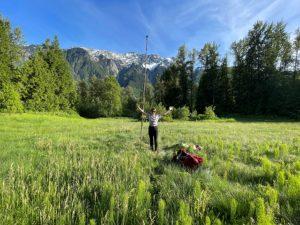
Over 10 days in the spring, four stationary acoustic recording stations are installed around the valley and two mobile driving transects are completed. Both methods record bats acoustics which are analyzed and produce a report. Insect paper – a sticky sheet mounted to the top of the car driving the transect collects insects to analyze as a food source for bats.
Thanks to all the volunteers that helped set up the stations, drove the transects (at 20km/hr it takes a long time to drive Meadows Rd!), and allowed us access to the station sites (including the Sunstone Pemberton Golf Course and BC Parks).
The data collected allows monitoring activity levels of different species and comparative activity over time. The data has been transferred to the Wildlife Conservation Society and will be analyzed by experts.